Thursday, July 8, 2010

The Last Post ; Home again, wiser perhaps?

Frost on fences and grass up to about 1 metre high: a Richmond morning at -4.8 degrees
Thick frost carpeting the yard area at Richmond TAFE
The bleak outlook on the -4.8 degree morning at Richmond

Returning home to a colder than expected mid-winter with temperatures at Richmond at an all-time record low of -4.8 degrees has been quite an adjustment, especially after making a point of telling Europeans that we have 20 degree days in winter. Weather aside, I have been asked by many people to describe what I had seen and learnt during my study trip. Unfortunately most expect you to tell them in 25 words or less (unlikely for me) and glazing of their eyes generally indicates a drop in listening intensity shortly afterwards.

To briefly summarise my thoughts I will note what took my interest as being different, better, useful or noteworthy
  • Awareness of alternative energy sources is much greater in both the farming community and general community in the places I visited. Wind and solar power systems are more widespread and more generally accepted that they are here. Government action to subsidise the purchase and installation of these systems has been needed, but it comes at a benefit to the country, not at a cost.
  • The intensity of grain farming in the places I visited was greater than that practised here. The level of inputs (fertiliser, seed, sprays) is much higher, even in areas where nitrate loss into waterways is critical, but yields of over 8 tonnes per hectare in wheat are achieved. A less inconsistent climate helps, and lower evaporation rates and more effective rainfall contribute to the outcome.
  • Animal production is quite similar to that practised here, allowing for the winter management of grazing animals. Growth rates are probably higher under their conditions in Europe as the provision of a balanced, grain-based diet is guaranteed under shedding in winter. Higher feed conversion ratios are expected under cooler European climates than in Australian conditions.
  • There seems to be a greater value placed on the business of farming by the general community in England and Germany than perhaps is exhibited in Australia. Tradition has something to do with this attitude as well as the historical threats of starvation during times of major upheaval. The acceptance of living near a farm (if you are a villager or a town inhabitant) or of farming near a village or town (if you are a farmer) is at a higher level than that I see during my travels in Australia.
  • Education of agriculture students at college and university level in England is relatively consistent with that in Australia. Greater emphasis on practical activities can be seen in some of the institutions I visited (Bicton College, Writtle College, Harper Adams) than in others (Royal Ag College, Otley College) but my deepest memory is of a comment made to me that agricultural education is "in a period of great churn at present". I would say that this reflects directly the position we are in at the TAFE level and the university level in our area.
  • The system of planning for urban development in England is considerably different to that in NSW. An offer of land for development is made by a landholder in response to an expression of interest from the council. Resumption of land for development is a practice not often undertaken.
  • How much of the differences I noted are due simply to the reason that England and Germany are mature societies rather than a still-growing society such as Australia I cannot determine. I'm sure if you live in a house next to a farmer's field, and your family has lived there for generations, then you are accepting of the situation.
  • The presence of allotments in both England and Germany are intriguing and amusing. The English allotments were established on public land (near railways and parks) as part of the 'Dig for Victory' campaign during WW2. It is reasonable to suggest that the German versions were established at the same time for a similar (if differently named) purpose. People erect sheds and flagpoles and establish a home away from home as an escape from life, work and family members. I might suggest that there will be fewer English and German flags fluttering in the breeze now than during my visit in May and June. In Australia our housing generally allowed for a garden of some sort (flowers, vegetables) in our yard rather than seeking another place to dig and scratch. Newer trends in housing might indicate a need for the provision of allotments in Australian subdivisions in the future.
  • My final report on my study tour will be made from a close edit of the words included in this blog. Distilling 3000 words for the report from more than 12000 already written will be a task of Herculean proportions. I would appreciate any hints, help or advice that anyone might suggest, that is if anyone is still reading or listening. Anyone, anyone......??!

Tuesday, June 22, 2010

Hof Hahlgarten organic farm, Fruecht

The view southwards from the farm and the reed beds used to 'polish' household waste water

The key implement for weed control in maize crops without using chemicals


A re-locatable hen house


An acknowledgement of the role of Rudolf Steiner in organic agriculture in this area


An area for wildflowers and herbs


A crop of cereal rye that was over 1.6 metres tall, which allows more straw bedding to be made after the grain is harvested


Part of the 10 hectares of potatoes with the milkers in the background


The organic vegetable production area


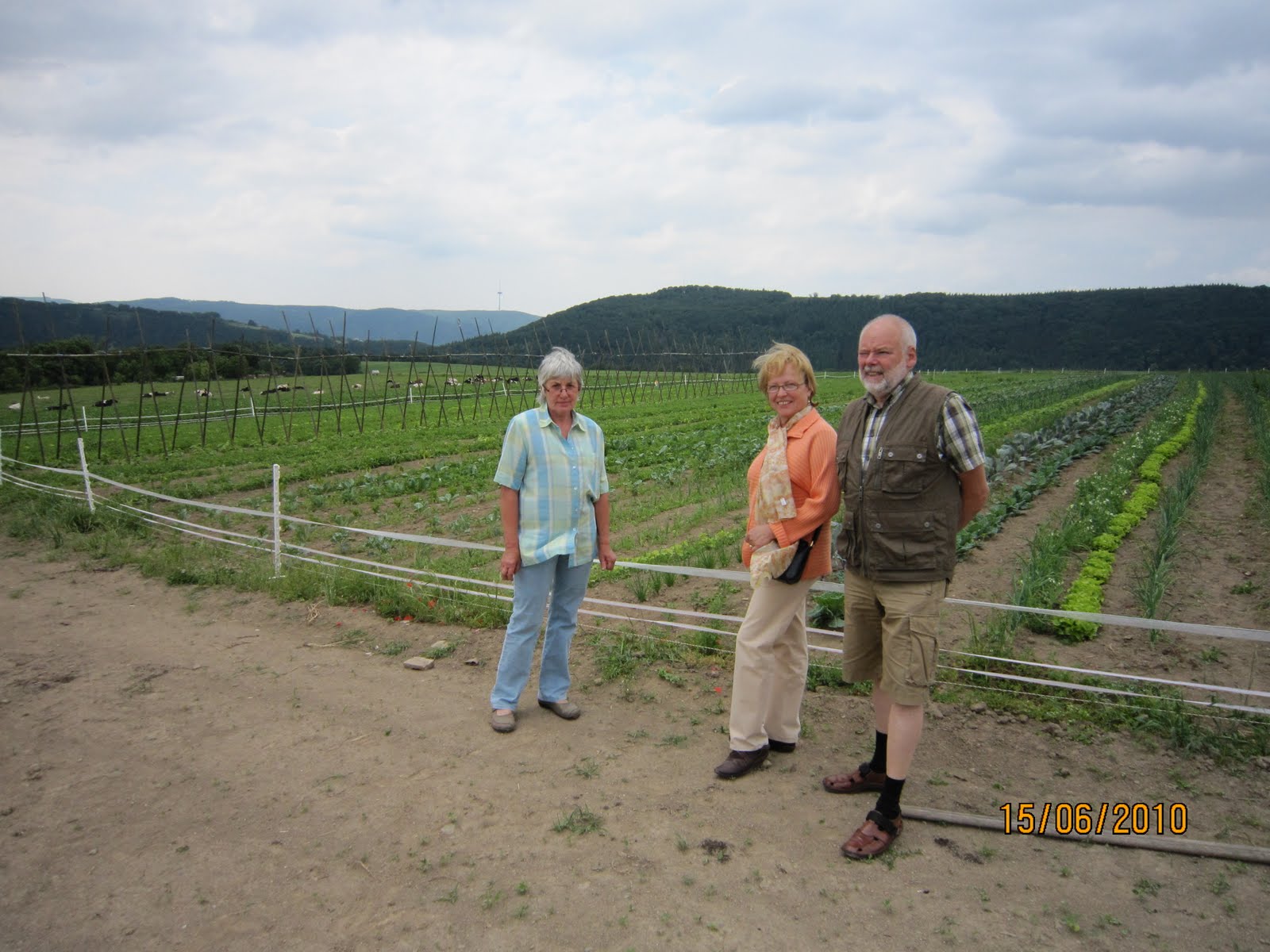
Frau Margret Weinig, owner and manager of Hof Hahlgarten organic farm, with Lucia and Albert Zinndorf


Beef bulls destined for the on-farm processing centre


The real driver of the production system on this farm: composting manure

Hof Hahlgarten is a family-run organic farm located at Fruecht, near Lahnstein in the southern Westerwald region. The Weinig family produce a wide range of organic farm products and sell them direct from the farm shop or through a growing network of customers.

The farm is located on land that had been used by Rudolf Steiner and his farming followers in the development of bio dynamic agriculture in the early part of last century. A plaque (see photo) notes the contribution of the Steiner methods to the production of wholesome produce. The Weinig family continue the chemical-free methods on the 180 hectare property.

There is a planned rotation of crops and pasture on the property that follows the traditional method of cereal, maize, legumes, wheat then oats. Potatoes are included in the rotation as well as triticale. Vegetables, herbs and flowers are grown in a 1 hectare plot. Grain is used for animal feed as well as some being processed for flour.

The farm produces bio-milch as its primary product, some being sold through a major organic distributor Uplaender. Milk is retained at the farm and processed into cheese and yoghurt. Beef animals and pigs are fed and slaughtered and the farm has a butchery and meat processing factory which is used for production of sausages, salami and other meat products. Eggs are produced by free-range chickens housed in re-locatable sheds. These products are sold through the farm shop or by subscription to an organic box of produce.

Hof Hahlgarten utilises the volunteer work of a group of organic farming followers who 'donate' their time and work efforts to maintaining the farm. Frau Weinig indicated that chipping weeds in the flower and herb gardens was a much sought after task as opposed to working in the larger vegetable garden.

The real nutrient driver of the farming system at the farm is composted manure and straw. Regular removal of manure from the sheds and replacement of straw is practised, with an impressive pile of composted manure being readied for incorporation into the soil for the next crop planting. If insufficient straw is produced on the farm then it has to be sourced from other organic producers. The crop of cereal rye photographed above is over 1.6 metres tall, much taller than similar crops grown under conventional methods. The extra height gives a greater harvest of straw and reduces the need to buy in extra from other farms. This reflects the general ethos of the farm in one product also providing inputs for other parts of the system.

Farming without chemicals requires greater manipulation of farming techniques than conventional farming. The control of weeds in a maize crop is essential to ensure good establishment and early growth. The family plants the maize seed deeper than would be done on a conventional farm and uses a spring tyne cultivator to remove weeds up until the plants are 15-20 cm tall. Better root development allows the maize seedling to withstand the abrasive effects of the cultivator. Other allowable inputs under the organic production codes are used at the farm including neem oil sprays to control pest problems in potatoes.

Frau Weinig indicated that the desire to produce top class organic produce came from the necessity to eat the best food available. She spoke of the difference that natural sources of food made to all people and animals, and pointed out some nearby health institutes that promoted healthy lifestyles. She has presided over a growing business that is capable of providing high class natural food products for a health-conscious community. A simple measure of food quality was shown by her observation that the cheese produced by the cows during the summer months was better tasting and lasted longer on the shelf. The cows have unrestricted access to pasture during the warm season but are housed during winter.


The sign indicating Bio-milch (organic milk)


The Herbst dairy farm

Solar power panels on the cow barn at the Herbst dairy in Breitenau, Westerwald, Germany

Nadine Schwind (an Agriculture student on farm placement) and Denise Herbst


Inside the cow barn


A maize silage clamp


The farm produces milk for the 'Hochwald' dairy company

The Herbst family operates a dairy near the village of Breitenau, not far from Koblenz in Germany. The farm covers 180 hectares on a number of sites apart from the main farm, and there are 120 ha of pasture and grassland as well as 30 ha of wheat and 30 ha of maize.

Holstein-Friesian cows are used in the milking herd and a small number of Limousin beef cattle are fed. Artificial insemination is used for the older dairy cows after they are mated as heifers to H-F bulls. The herd of heifers is grazed at a section of the property about 2 kilometres from the main farm.

The cows in the dairy herd are allowed access to pasture land in the warmer months and are otherwise housed in a large, high-ceiling barn. The sheds on this farm mirror the changes in animal housing over the last 20 years with the older sheds having low ceilings and dark interiors and the newer sheds being more light and airy. The remaining beef cattle are housed in the oldest shed and it was much less pleasant to visit than the new sheds (see photograph of new shed).

Cows calve for the first time at 24-26 months and calving takes place all year round. The average cow in the herd will have around 6 lactations but the oldest resident cow at present is 15 years old, an outstanding individual. The herd production average is just above 10000 L. The diet for the cows includes silage (whole plant maize and pasture), wheat, soybean meal, spent brewers' grains and fresh pasture. The herd is milked in a 4-a-side parallel parlour which, according to Frau Herbst, needs replacing. The family is considering a system utilising 2 robotic milking stations.

The current Herbsts are the second generation to run the farm, with the original dairy commencing with 20 cows in the older sheds over 25 years ago. Any increase in herd size now is limited by the old-style milking parlour.

The mother cow beef cattle operation is being discontinued as returns from beef do not justify the labour and feed inputs.

No bio gas production is undertaken on this farm as the slurry is applied to the extensive pasture area as well as the composted straw and manure solid wastes. As is usual on farms in this area, a large photovoltaic array was in place on the roof of the cow barn.

My thanks to my guides to the farm, Denise Herbst and Nadine Schwind, a student of Agriculture at a university near Berlin, who spoke perfect English with a lilting Irish accent.


Saturday, June 19, 2010

Schoenberger Hof : Dairy farming in the modern day

A view of the Schoenberger-Hof dairy farm, Heilberscheid, southern Westerwald, Germany

The new high-capacity milking parlour


Maize in the foreground and winter wheat in the background


The biogas unit used to ferment slurry and wastes and maize silage


Cows feeding inside the new dairy barn


Andreas Schoenberger, Albert Zinndorf and Gerhard Schoenberger outside the new dairy barn


Inside an older dairy barn, now an area for heifers


A disc seeder capable of sowing crop or pasture seed at 6 hectares per hour

The Schoenberger family have run a dairy farm at Heilberscheid in the southern Westerwald region since 1966. Farming 260 hectares, they are currently milking 200 Holstein-Friesian cows. Having started in 1968 with 40 cows the family has improved their facilities about every 9 years building more sheds and providing better conditions for the cows. New buildings constructed in 2009 include a cow barn with 250 cow capacity and a state of the art milking parlour capable of milking 120 cows per hour.

Half of the farming land is used for cropping with rape, maize, wheat, oats and barley in the rotation. Silage and hay are cut from the remaining land area. Machinery on this farm is up with the big end of town: 2 tractors in excess of 200 hp, high capacity sowing and harvesting implements and now non-inversion tillage equipment. Andreas Schoenberger indicated that previously cultivation had been carried out fairly often and at depth with a mouldboard plough but now most paddocks are cultivated with power harrows. The topsoil across the farm is about 350 mm deep and well drained but layers below this include many smooth rocks.

The dairy cows are housed all year round, and currently production averages 9500 L per cow over a 310 day lactation. Cows are fed soybean meal, corn silage, grass silage, wheat and barley. Spent brewers' grains and rapeseed pellets also form part of the diet. Forty hectares of maize are grown each year as well as 30 ha of oilseed rape, 70 ha of wheat and 10 hectares of winter barley. Fertiliser rates are high to ensure reasonable yields in crops and pastures.

The farm has a high capacity anaerobic digestor which uses substrates such as dried manure, slurry and maize silage to produce methane which is then converted to electricity and fed into the power grid. The new cow barn is covered on the southern side with an enormous photovoltaic array which is capable of returning in excess of 9000 Euros to the farm per month in the sunny months.

The Shoenberger Hof dairy is an efficient and impressive animal production unit designed to operate efficiently and with minimal environmental impact.


Friday, June 18, 2010

Pferdeland: Meyer Family farm, Westerwald, Germany

The half-timbered farm house at the Meyer family's "Pferdeland" near Grenzau

Sowing machinery (with a detachable power harrow front), hay mowers and silage choppers

Part of the mother cow crossbred herd in shedding. Note the silage and hay stored behind the pens.

Solar panels cover an area of 60 metres by 25 metres on the arena shed

An impressive equestrian arena with dust-settling fogger line in operation

The symbol of quality assurance in farm production in Rheinland-Pfalz

Pferdeland: Meyer Family farm

The Westerwald is a picturesque region of farms, villages and forests in central western Germany. It was the northern limit of Roman settlement due in part to the distance from Rome and the climatic conditions. It was the centre of my interest for a number of days, and its proximity to a number of cities such as Koblenz and an abundance of towns and villages qualifies it as a peri-urban area. The farm enterprises undertaken in the area are broad and varied, and the scale of farm investment and size differs greatly within the region.

The Meyer family farm 80 hectares of land near the town of Grenzau. Willi Meyer and two of his sons form the operational team at the farm, with the younger son Tobias getting ready to go to university to study management in agriculture. Thirty hectares are used to grow cereals with 50 hectares of grassland and pasture. Cereals grown in rotation are oilseed rape, wheat, oats, barley and occasionally peas. Ryegrass forms the perennial base of pastures.

Formerly a farm principally producing grain and pigs, the farm was a dairy for a number of years. Pig production was limited by small facilities by modern standards, and an increase in the number of privately owned pleasure horses prompted a change to an agistment facility 20 years ago. Now providing accommodation for 60 horses on a permanent basis, the farm offers a range of options for owners including various scales of care (full board, feed only, boxes or yards). Most of the owners live in towns within 10 kilometres but the density of population means most have no room for a horse at home.

Cereal grain produced on the farm is consumed by the horses and a herd of mother cows (vealer mothers). Hay and silage is produced from the grassland with a special silage product being produced for the horses. It has a lower moisture content and a different bacterial inoculant to the silage produced for the cattle. The family has a number of tractors with capacity of more than 130 hp as although small paddocks are used sometimes jobs have to be done in a short period of time due to the likelihood of poor weather. All animals on the farm are shedded during winter.

In an area that receives 750-800 mm of rainfall, soils on this farm are not as productive as others in less hilly areas. There is a scale used in German agriculture to rate the productivity potential of soil out of a possible 100 points. The farm has soils in the range of 50 to 70 points. Fertiliser is used at sowing and again in crops when they reach 100-150 mm when urea is applied. Up to 6 tonnes of wheat per hectare can be expected at this farm, and up to 8 tonnes per hectare in flatter areas with better soils.

The shedding on the farm allows for changes in the size of the cattle herd. While currently 20 cows and their offspring are in the pens, over 80 cows and followers were on the farm last year. Price changes led to a reduction in numbers, but an increase can be accommodated quickly. Calves are grown out to 700 kg plus on a diet of milled grain and silage. The herd uses a Limousin bull over Fleckvieh and crossbred cows.

Willi Meyer expressed the regrets of farmers worldwide as he discussed rising prices of fertilisers, chemicals and fuel while noting the accompanying drop in commodity prices. He also wondered at the various state and Federal German agriculture departments' responses to diseases such as Bluetongue, where a vaccine had become available for use but no one department would sanction its use. Farmers were acting to ensure correct action was being taken to control the problem but felt little support. He also regretted the position of a farmer as a price taker and compared this to the ability of others to speculate as opposed to being a producer.

The family has moved to take advantage of rebates and contracts by establishing a major photovoltaic array on the dressage arena shed. The family has also converted one of the tractors to run on rapeseed oil when tax inducements made this action economically favourable. The tax advantage in this sector has been reducing and in 2011 there will be no difference between diesel and rapeseed oil and therefore no incentive to continue the practice.

The family has contracts with a number of local villages to clear roads of snowfall during winter. It is an onerous task with starts in the colder months before 3 am. The continual spraying of salt onto cleared road surfaces behind the tractor has led to extensive surface rust on components of the tractor.

Oppenheim: A small city with some big ideas on sustainablility

A view of the River Rhine and assorted transport methods from Nierstein, a village close to the city of Oppenheim
Solar panels on numerous houses in this nearby village

An impressive photovoltaic array in a field on a farm near Oppenheim

Wind power generators on the hills near Oppenheim

Green waste is mixed with this composted sewerage solid waste to provide farm fertiliser

Oppenheim on the River Rhine: Recycling and Renewables

Oppenheim is a small city on the River Rhine near Mainz, not far from Frankfurt in Germany. It boasts an impressive cathedral, the construction having started before the Reformation as a Catholic cathedral but its completion many centuries later now sees it as a Protestant cathedral, noted also for its stained glass windows. The ruins of a castle can be seen above the city and an impressive series of tunnels from the Middle Ages were unearthed immediately under the city’s marketplace sometime in the 1980s.


The most impressive feature to Oppenheim is how it recycles the products of modern living. A modern water treatment plant is located at the edge of the city’s houses near the Rhine. Liquid and solid sewerage waste is removed and the residual water treated and returned to the river. Solid wastes undergo further treatment and are then mixed with composted green waste from the nearby collection centre and further composted then sold as fertiliser for farms. The liquid wastes are anaerobically digested and the resulting methane is used to heat the city swimming pool.


Houses and buildings of all shapes, sizes and locations have been fitted with photovoltaic arrays. Private houses, some public buildings and many farm buildings, new and old, display the solar panels. The German Federal government has encouraged owners to take advantage of purchase and installation cost reductions and owners sign a contract with the government to be reimbursed for power going back to the grid for a 10 year period. The payback period for the costs of purchase and installation seems to be towards the end of the 10 years, so after that any power produced is effectively income. Some owners have invested in solar power as a form of superannuation. The biggest installation in the area is a farmer’s field of around 10 hectares which is probably the only crop that will have a guaranteed return over the next 10 years completely independent of rain or temperature.


The hills to the south of Oppenheim are dotted with many wind power generators. Erected over the last 7 years, there are over 100 windmills. Some of the older ones are already being replaced by new, more efficient generators, and like the solar panels, there is a contracted arrangement to sell power back to suppliers at a guaranteed price. The Federal government has set a target of 35% of base power from renewable sources within 5 years. While this seems large by Australian standards, it is some way behind other countries in northern Europe especially Denmark. It is possible to stand on some of these hills and have, within the one view, sight of windmills, photovoltaic arrays and a nuclear power plant. It is one of the oldest plants in this region and there has already been much debate about its intended lifespan and decommissioning. It really is the new among the formerly new.


The hills within the vineyards and cropping areas are relatively steep and inter-row cultivation in grapes and general cultivation practices for crops still take place. The grape inter-rows are cultivated on a year-about basis to allow incorporation of nutrients and also allow machinery to travel along the rows. Peas are also grown as a green manure crop between the rows. There are deep silt traps strategically placed around the hilly areas to catch any eroded soil before it has a chance to enter drains or waterways. These are regularly cleaned out and the soil is returned to farmers up the hill.


All of these features within, near to and surrounding the city add to the sustainability of the community, rural and urban.

The Martinshof Winery, Dienheim, Germany

Winemaker Achim Martin outside the cellar door at Martinshof Weingut in Dienheim

Werner Wehmeier with winemaker Achim Martin

An eye-catching label on a Martinshof riesling

The Herrenberg vineyard area above the city of Oppenheim. One of these blocks produces grapes made into fine wines by Achim Martin

The Martinshof Winery, Dienheim, Germany

Achim Martin is an enthusiastic and skilled winemaker in his early thirties living in Dienheim, a town near Mainz in Germany. The family has been making wine from grapes grown alongside the River Rhine for a number of generations and Achim completed a course in winemaking at Giesenheim near Wiesbaden about 10 years ago.

Succession planning within family farms is sometimes problematic no matter which continent you happen to be on, and it has taken careful planning for Achim to take the business to where it is now. In the traditional method of succession the son learnt the business from the father in the vineyards and winery but the establishment of oenology courses in the 1970s and 80s has led to a new generation making wine along the Rhine.

The opening of different markets within the 1970s saw expansion of areas under plantings of new varieties to this part of the Rhine. The new breed of winemaker is taking some of the plantings back to more original varieties such as Riesling and Gewürztraminer and concentrating on very high quality and less quantity. Growers tend to have the choice of growing and selling on their grapes to a processor or growing and then processing their own. Achim makes wine from about 70% of his grapes currently with the remainder being sold to a high quality processor who bottles the wine for clients but the region of origin is not identified.

Vineyards are licenced in the EU with strict limits on what can be produced and where it is produced. It costs about 2.8 Euro per square metre of vineyard for the licence. The licencing scheme currently in place will end within 5 years and most winemakers are positioning themselves to ensure their viability after the change.

Achim is involved in a small community of local winemakers who assist each other especially in tasting new vintages and constructively criticising the products. Blind tastings are held to enable each vintner to objectively comment on each new vintage of a variety of grapes. Achim confessed to surprise at one such tasting when he outlined some steps to improve one wine only to find that it was one of his own.

A new method of marketing his wine takes Achim to many areas within Germany and to other European countries. Concentrating on his white wines, he has made inroads into potential markets in The Netherlands where he holds tastings and wine sessions. Within Germany he has a list of customers and each spring and summer he spends a weekend in a restaurant in a particular area and allows his clients to taste the wines he is about to release. This allows clients to choose their wines having tasted them without the need to travel. Delivery of purchased wines takes place during the following week. His wines are not sold at supermarkets or other outlets, just by mail or phone order or at the cellar door.

The 27 hectares of grapes Achim grows are located in several areas within a relatively short distance of the winery. Some of the vineyards adjoin housing areas and management of activities within the vineyards needs to be done in a way that allows general vinicultural work without causing any great difficulties to neighbours. Pheromone packets are used extensively to attract male moths rather than spraying. Some systemic fungicides are sprayed to ensure the quality of grapes at picking.

There are 2000 wine producers in the Rhine-Hessen wine growing region managing some 26000 hectares of vineyards. Achim Martin is currently placed within the top 30 producers but has an ambition to be in the top 10.